In 4D, there are two convex finite uniform polychora that are non-wythoffian; that is, their vertex sets cannot be generated by one point orbit of a Coxeter group (a symmetry group generated by reflections). Because of the fact that uniform polytopes are vertex transitive and have a single edge length (which also means they have a unique circumsphere), their duals are facet transitive with a single ditopal angle. This makes them excellent dice in all dimensions, being both perfectly globally fair and somewhat locally fair (though those without central inversion symmetry - a.k.a. a “top” side - are harder to label or read results from).
In the case of duals of non-wythoffians, there is another notable property: some of the ridges beetween facets are not contained in mirrors of the polytope’s symmetry group. This stands in contrast to the duals of wythoffians, whose ridges are each contained in a mirror (this itself is a consequence of every edge of a wythoffian uniform being perpendicular to a mirror, which is not the case in a non-wythoffian).
Moving on, here we have vZome models of projections of these two dual uniforms.
First, we have the dual to the Snub 24-cell, here above called the Quatro-24-diminished 600-cell due to a possible construction method. One cell is highlighted with faces rendered. In total, this polychoron has 96 cells, makking it a d96 in 4 dimensions.
Next, we have the dual to the Grand Antiprism, here above called the Grand Antitegum in analogy to its unique name. One cell is highlighted with faces rendered. In total, this polychoron has 100 cells, making it a d100 in 4 dimensions.
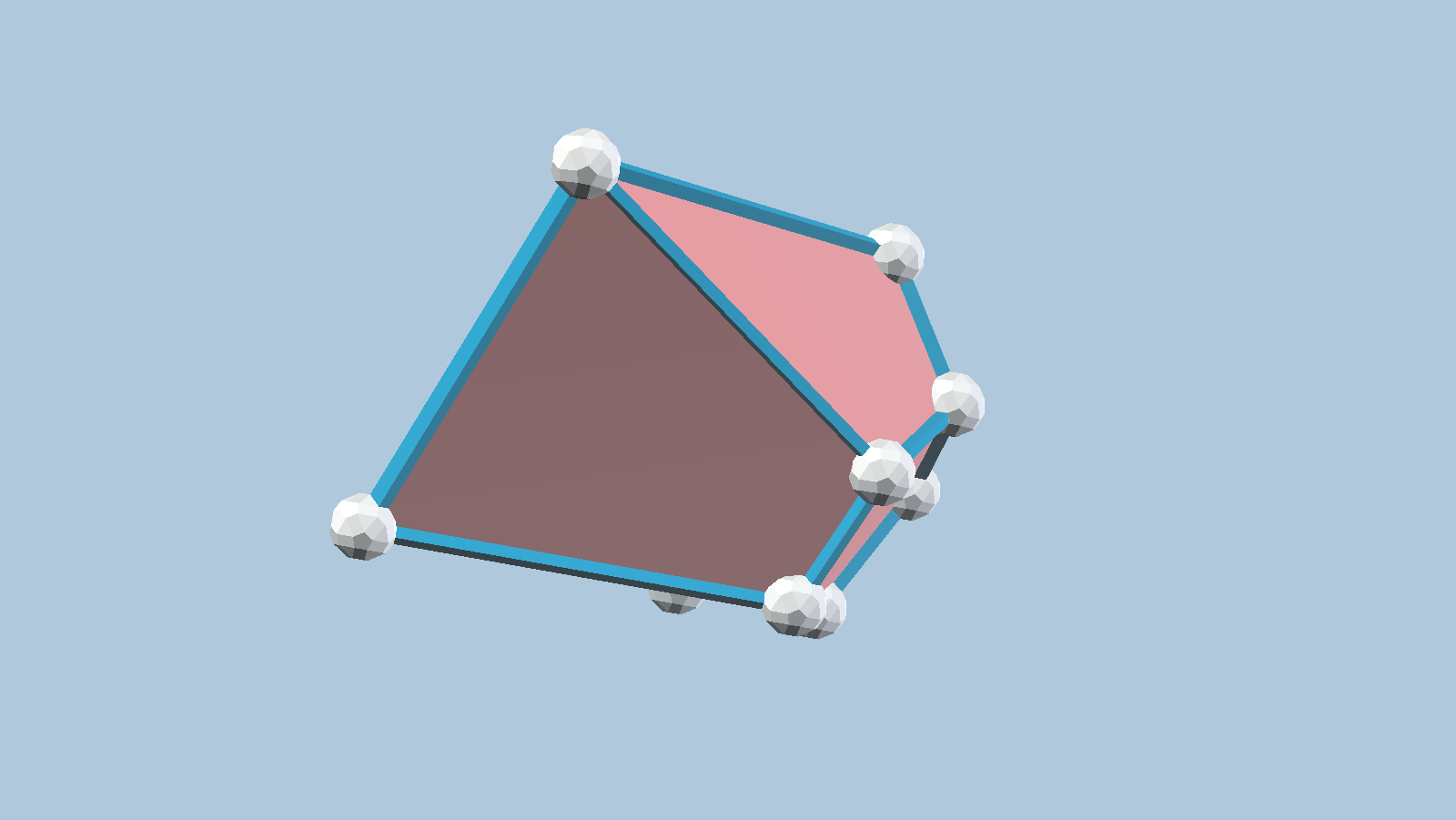
Lastly, we have renderings of the cells of the two dice, undistorted by projections. The cell of the Quatro-24-diminished 600-cell is the dual of the Tridiminished Icosahedron, a partially stellated Dodecahedron over three non-adjacent faces. In this case, the faces which are not contained in mirrors are the triangular ones. The cell of the Grand Antitegum is similar, the dual of an Icosahedron diminished on two adjacent vertices, allowing the new faces to become trapezoids. It is again a partially stellated Dodecahedron, over two adjacent faces with the two “spikes/pyramids” joined into a wedge shape. In this case, the faces not contained in mirrors are the kites and the pentagons; i.e., any other than the trapezoids.